Skip to content

Choosing the right employment arrangement

Once you have decided to employ someone, you need to decide the type of arrangement that suits your business. This decision influences your ongoing costs, your legal responsibilities and the availability of the people you hire.

Hire a permanent employee

If you decide to take on a permanent employee, you should:

Permanent employees can work full- or part-time hours. You will need to decide how many hours you need the person to work for each week.

An employee can request flexible working arrangements, meaning they can ask for a change to when, where and how often they work. GOV.UK explains how you must deal with flexible working requests.

Hire full-time staff if:

  • There is enough work available to fill a working week and you can afford the costs of a full-time role
  • It would be difficult to split tasks between people

Hire part-time staff if:

  • You only need help on specific days or during specific times of day
  • You want to start slowly and see how you manage costs before committing to a full-time role

Use a fixed-term contract

You can employ someone until a fixed date in the future under a fixed-term contract. Explore this option if:

  • your business has increased demand at certain times of year – for example, retail businesses are often busier in November and December
  • you need someone to cover another employee’s maternity leave or extended sick leave
  • you need more help or specialist skills to complete a specific project or contract

A fixed-term employee is entitled to the same rights as a permanent employee for the duration of their contract.

Take on an apprentice or intern

Taking on an apprentice or intern can be a cost-effective way of building your workforce, as long as you have the time to invest into that person’s training and development.

Hiring an apprentice

Apprenticeships are a government-supported route to recruit and train someone and can be a great way to invest in your business’s workforce, developing employees with the exact skills your business needs.

Apprentices are employees and must be paid at least the apprentice minimum wage rate and they must spend at least 20% of their time on off-the-job training.

There are different apprenticeship schemes in England, Scotland, Wales and Northern Ireland but all offer some financial support to hire an apprentice. Eligible employers in England who take on an apprentice aged 16-24 can get a hiring payment of up to £2,000.

Taking on an intern

Interns are typically students or recent graduates who gain work experience in a specific role or industry through short-term placements in a business. The term ‘intern’ has no legal meaning in the UK.

If an intern is doing any work, rather than just observing others working, you must pay them at least the minimum wage. Their other rights will depend on whether they are a worker or an employee.


You do not need to pay someone if they are working for you through the government-backed Supported Internship scheme.

Use flexible or zero-hours contracts

Hiring someone under a flexible or zero-hours contract means you contract someone to work for you but do not guarantee them a set number of hours each week.

A zero-hours arrangement can be useful if you need flexibility. However, workers do not have to accept offers of shifts made under zero-hours contracts, which means you cannot guarantee worker availability.

Zero-hours workers have employment rights, such as the National Minimum or National Living Wage, paid holidays and rest breaks.

Your other responsibilities to staff on zero-hours contracts depend on whether they are categorised as workers or employees.

The Employment Rights Act 2025 introduces changes to zero hours and similar contracts. Employers will have to offer guaranteed hours, give reasonable notice of shifts and provide compensation for shifts which are cancelled, rescheduled or cut short without enough notice. Get ready for changes to employment rights.

Get support to hire

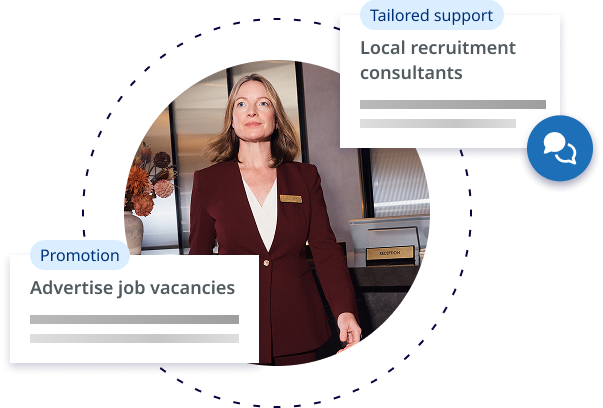
The UK Government provides financial and face-to-face support to help businesses recruit and employ people, in the form of tailored no-fee services from Jobcentre Plus Recruitment Consultants. This includes:

  • recruitment advice and planning
  • help to advertise vacancies and find quality candidates
  • arranging work experience and work trials
  • help setting up apprenticeships
  • filling your business’s skills gaps
  • extra support for complex recruitment needs

Backing you with recruitment support

Whether you have 1 vacancy or 100, our expert recruitment consultants are here to help you:

  • advertise your vacancies
  • sift applications and set up interviews
  • find the right people for your business
  • build your business's future workforce

Something went wrong. Please try again.

Was this page useful?

Thanks for letting us know

Can you tell us why this page was useful?

Do not share any personal or commercially sensitive information.

Cancel feedback form and refresh page

Thanks for letting us know

Can you tell us more about your feedback?

Do not share any personal or commercially sensitive information.

Cancel feedback form and refresh page

Thanks for your feedback